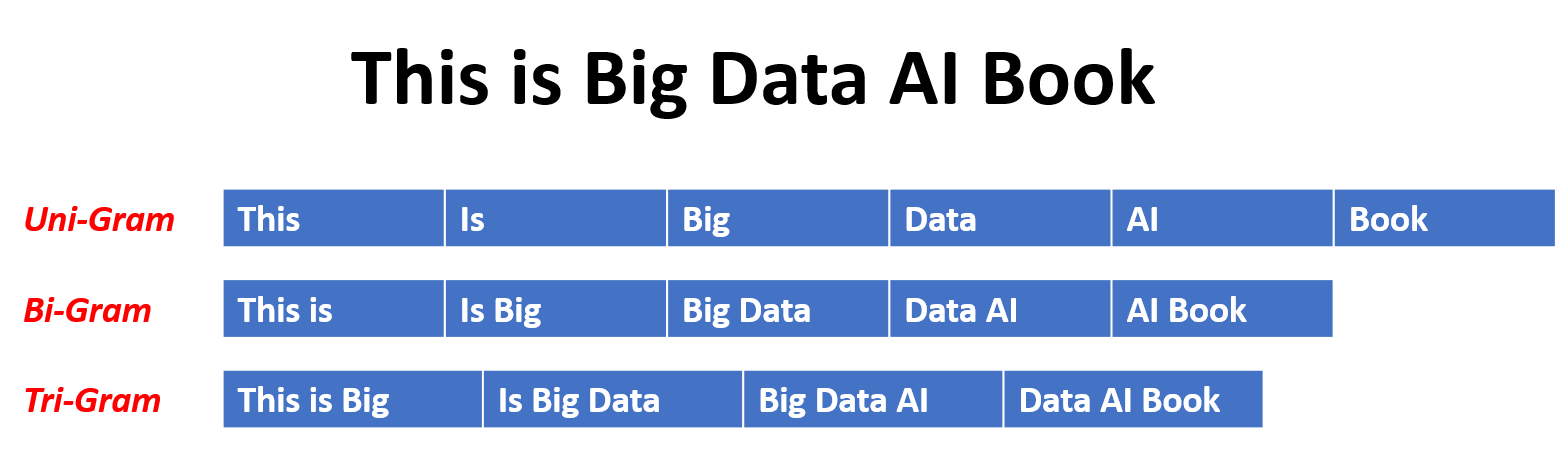

Generate Unigrams, Bigrams, Trigrams, n-grams etc in Python
To generate unigrams, bigrams, trigrams or n-grams, you can use python’s Natural Language Toolkit (NLTK), which makes it so easy.
First steps
Run this script once to download and install the punctuation tokenizer:
 import nltk
 nltk.download('punkt')
Unigrams, bigrams and trigrams
By using these methods you will get the lists for each:
from nltk import word_tokenize, bigrams, trigrams

unigrams = word_tokenize("The quick brown fox jumps over the lazy dog")
bigrams = bigrams(unigrams)
trigrams = trigrams(unigrams)
Hint for unigrams
For simple unigrams you can also split the strings with a space.
n-grams
To generate 4-grams (n = 4):
from nltk import word_tokenize, bigrams, trigrams

unigrams = word_tokenize("The quick brown fox jumps over the lazy dog")
four_grams = list(ngrams(unigrams, 4))
n-grams in a range
To generate n-grams for m to n order, use the method everygrams:
Here n=2 and m=6, it will generate 2-grams,3-grams,4-grams,5-grams and 6-grams.
from nltk import word_tokenize, everygrams

unigrams = word_tokenize("The quick brown fox jumps over the lazy dog")
grams_2_to_6 = list(everygrams(unigrams, 2, 6))
Real-World Applications
N-grams are used in many NLP tasks:
- Language Detection: Identify the language of a text based on character or word n-gram patterns
- Spell Checking & Correction: Find most likely next word to correct misspellings
- Machine Translation: Predict probability of word sequences
- Sentiment Analysis: Use n-grams as features for classification
- Text Prediction & Auto-complete: Suggest next words based on bigrams or trigrams
- Plagiarism Detection: Compare n-gram patterns between documents
- Information Retrieval: Index and search documents using n-gram frequencies
Working with N-gram Output
Let’s look at practical examples with actual output:
from nltk import word_tokenize, bigrams, trigrams
from collections import Counter

text = "The quick brown fox jumps over the lazy dog. The dog was very lazy."
tokens = word_tokenize(text.lower())

# Get bigrams and their frequencies
bigram_list = list(bigrams(tokens))
bigram_freq = Counter(bigram_list)

print("Bigrams:", bigram_list)
print("\nMost common bigrams:")
for bigram, freq in bigram_freq.most_common(5):
    print(f"{bigram}: {freq}")
Output:
Bigrams: [('the', 'quick'), ('quick', 'brown'), ('brown', 'fox'), ...]

Most common bigrams:
('the', 'dog'): 2
('the', 'quick'): 1
('quick', 'brown'): 1
...
Custom N-gram Implementation
If you prefer not to use NLTK or need a lighter implementation:
def generate_ngrams(text, n):
    """Generate n-grams from text without NLTK"""
    words = text.lower().split()
    return [tuple(words[i:i+n]) for i in range(len(words)-n+1)]

text = "the quick brown fox jumps over the lazy dog"

# Generate different n-grams
unigrams = generate_ngrams(text, 1)
bigrams = generate_ngrams(text, 2)
trigrams = generate_ngrams(text, 3)

print("Bigrams:", bigrams)
# Output: [('the', 'quick'), ('quick', 'brown'), ('brown', 'fox'), ...]
Handling Edge Cases
When working with n-grams, consider these important points:
1. Punctuation & Tokenization
from nltk import word_tokenize
import string

text = "Hello, world! How are you?"

# Without proper tokenization, punctuation stays
print(text.lower().split())  # ['hello,', 'world!', 'how', ...]

# With NLTK tokenization
tokens = word_tokenize(text.lower())
print(tokens)  # ['hello', ',', 'world', '!', 'how', ...]

# Remove punctuation if needed
clean_tokens = [w for w in tokens if w not in string.punctuation]
2. Stopwords
from nltk.corpus import stopwords

stop_words = set(stopwords.words('english'))
filtered_tokens = [w for w in tokens if w not in stop_words]
3. Minimum Frequency Filtering
from collections import Counter

bigram_freq = Counter(bigrams(tokens))
# Keep only bigrams that appear at least 2 times
frequent_bigrams = [bg for bg, count in bigram_freq.items() if count >= 2]
Performance Tips
- For large texts: Use generators instead of lists to save memory
bigrams_gen = bigrams(tokens) # Returns a generator, not a list - Use Counter efficiently:
# More efficient for frequency analysis from collections import Counter freq = Counter(bigrams(tokens)) - Vectorization with sklearn:
from sklearn.feature_extraction.text import CountVectorizer

vectorizer = CountVectorizer(ngram_range=(1, 2))  # unigrams + bigrams
X = vectorizer.fit_transform([text])
Common Mistakes to Avoid
- Forgetting to tokenize properly: Using simple
split()can leave punctuation attached - Not handling case sensitivity: Always normalize text to lowercase for consistency
- Including stopwords: Often skew results; remove them unless analyzing function words
- Not considering corpus size: N-gram frequencies need sufficient text to be meaningful
- Ignoring low-frequency n-grams: They may be noise rather than patterns
Next Steps
- Explore language models using n-grams for text generation
- Try Markov chains for probabilistic text generation
- Experiment with character-level n-grams for tasks like language detection
- Use TF-IDF weighted n-grams for better feature extraction
More info about the nltk can be found here



Leave a comment